Webinar recap - June 2026
Stop Overpaying for AI in Healthcare
Cost-smart clinical AI is not about swapping every task to the cheapest model. It is about spending model capacity only where clinical judgment, safety, and workflow reliability actually require it.
Replay
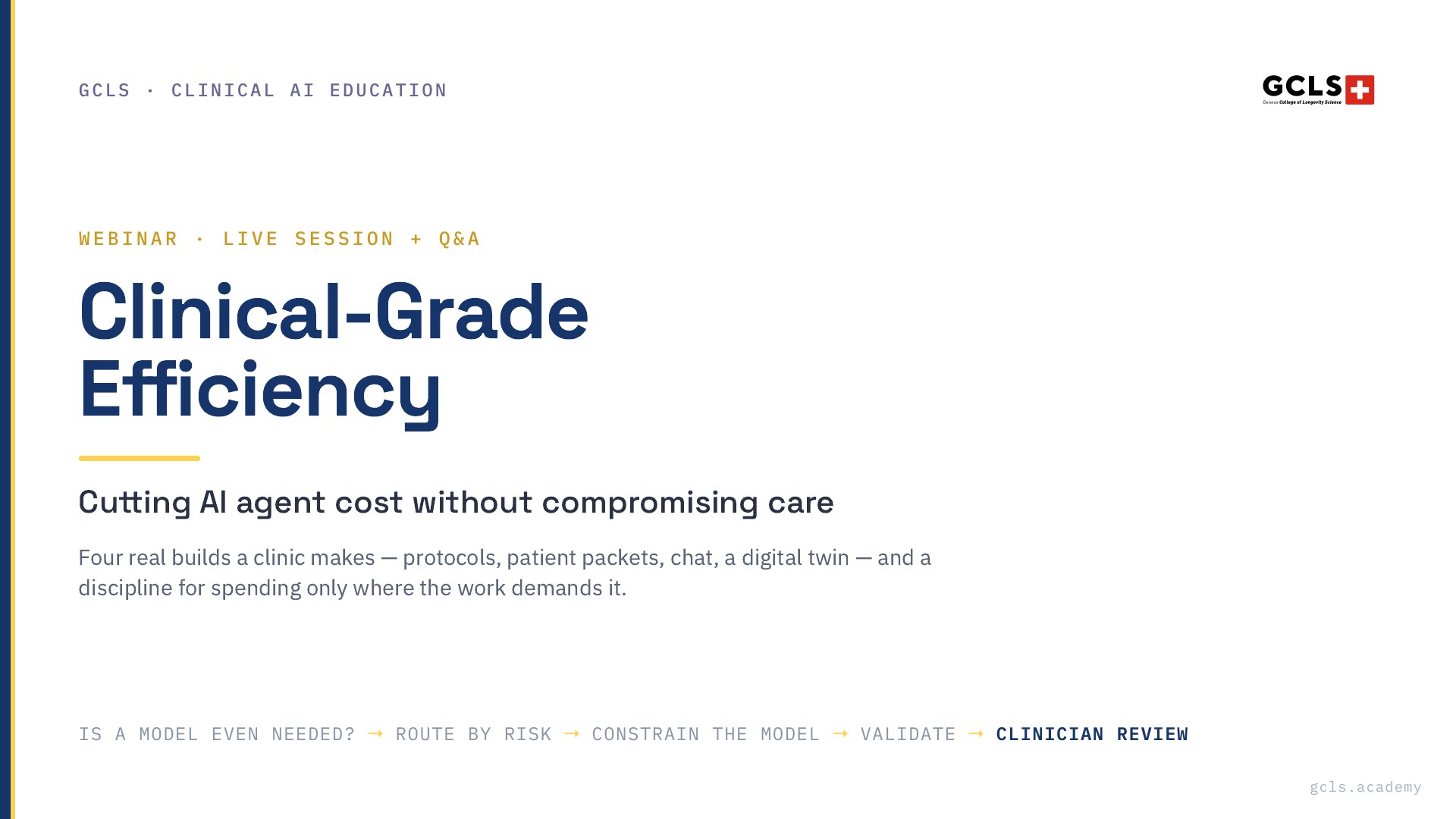
Clinical-grade efficiency
In this GCLS session, Dr. Omar Saleem walks through why agent costs climb after a pilot, how to route work by risk tier, and where evals belong before anyone cuts spend.
Open in Webinar HubThe pilot was cheap. Production was not.
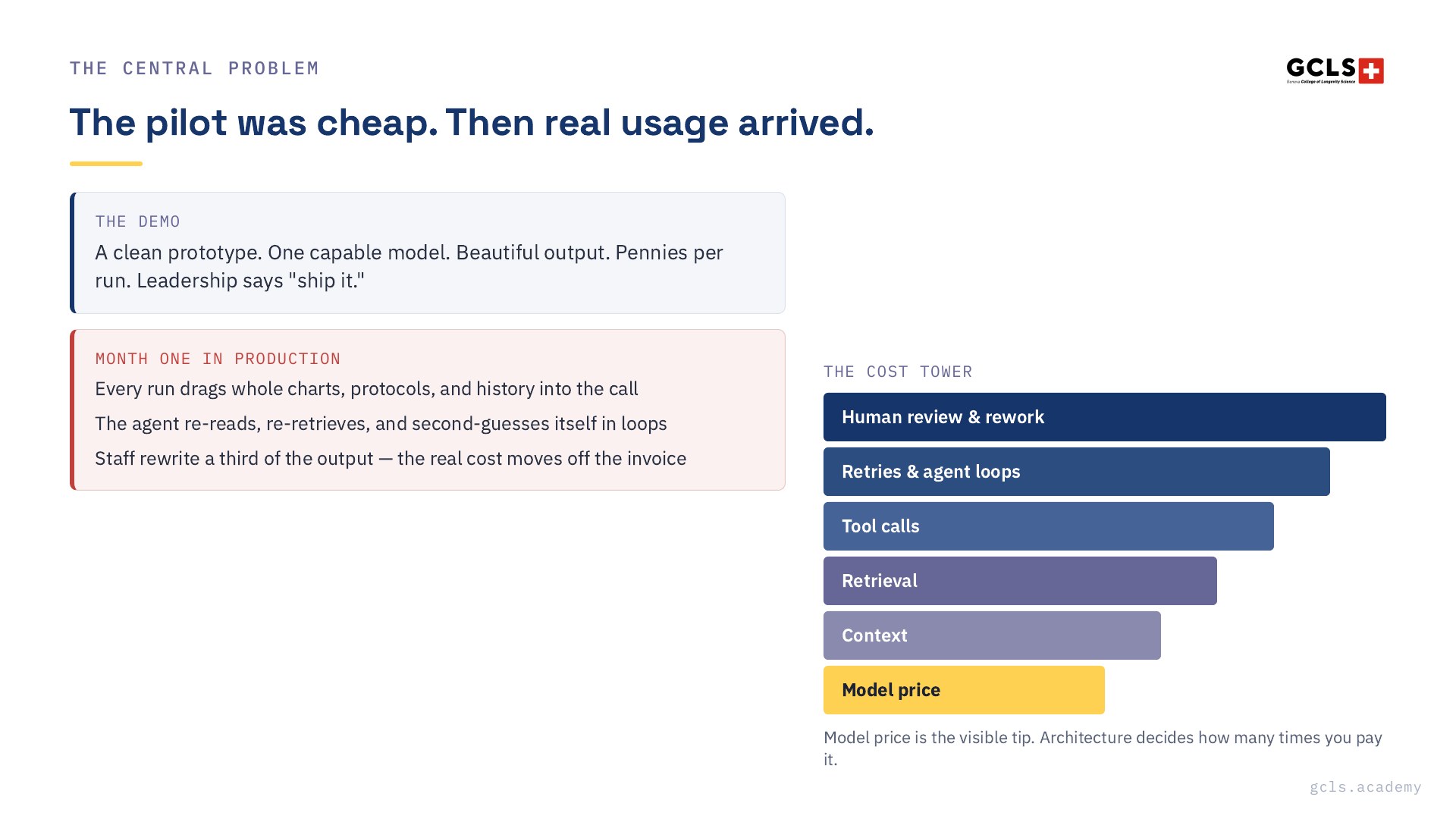
A clinical AI prototype often starts with one capable model, a narrow test case, and a handful of clean examples. The output looks good. The per-run cost looks trivial. Then real clinic usage arrives: longer charts, repeated retrieval, multi-step tool calls, loops, retries, edge cases, and staff correction. The invoice still shows model calls, but the real cost includes everything the system forced people to fix.
That is why the webinar framed cost as a quality signal. A bloated agent does not merely spend more. It usually reads too much, reasons in the wrong places, misses deterministic shortcuts, and hides review burden in the clinical team. The goal is not cheap AI. The goal is clinical-grade efficiency: removing waste while preserving the reliability clinical work requires.
In healthcare, cost is last
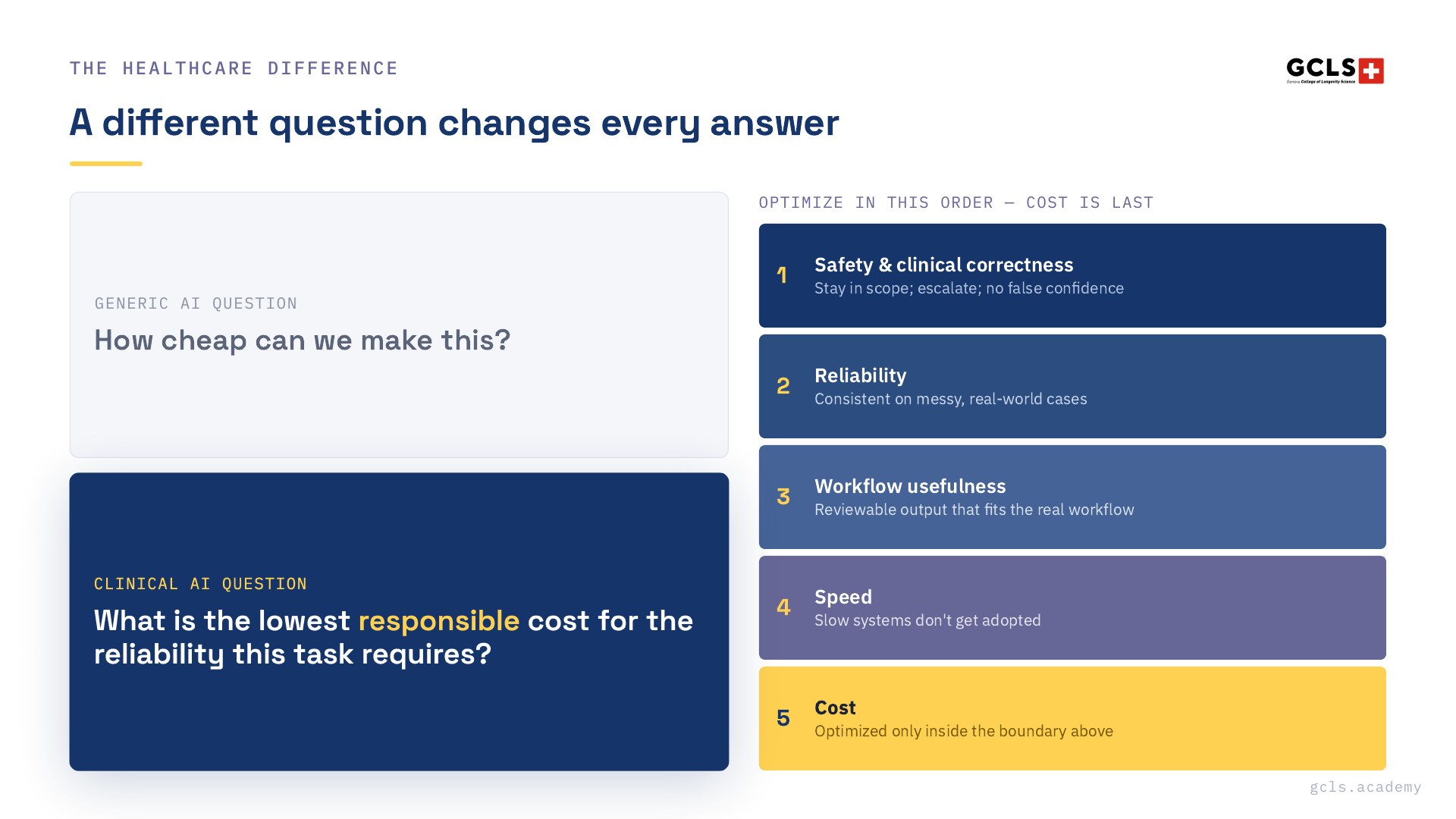
Generic AI optimization asks, "How cheap can we make this?" Clinical AI has to ask a better question: "What is the lowest responsible cost for the reliability this task requires?" That means safety and clinical correctness come first, followed by reliability, workflow usefulness, speed, and only then cost.
If a cheaper route drops escalation behavior, weakens citation discipline, or pushes more correction work onto clinicians, it is not cheaper. It is a liability with a smaller line item. Responsible cost optimization protects the clinical boundary first and then removes unnecessary spend inside that boundary.
Route by risk, not by habit
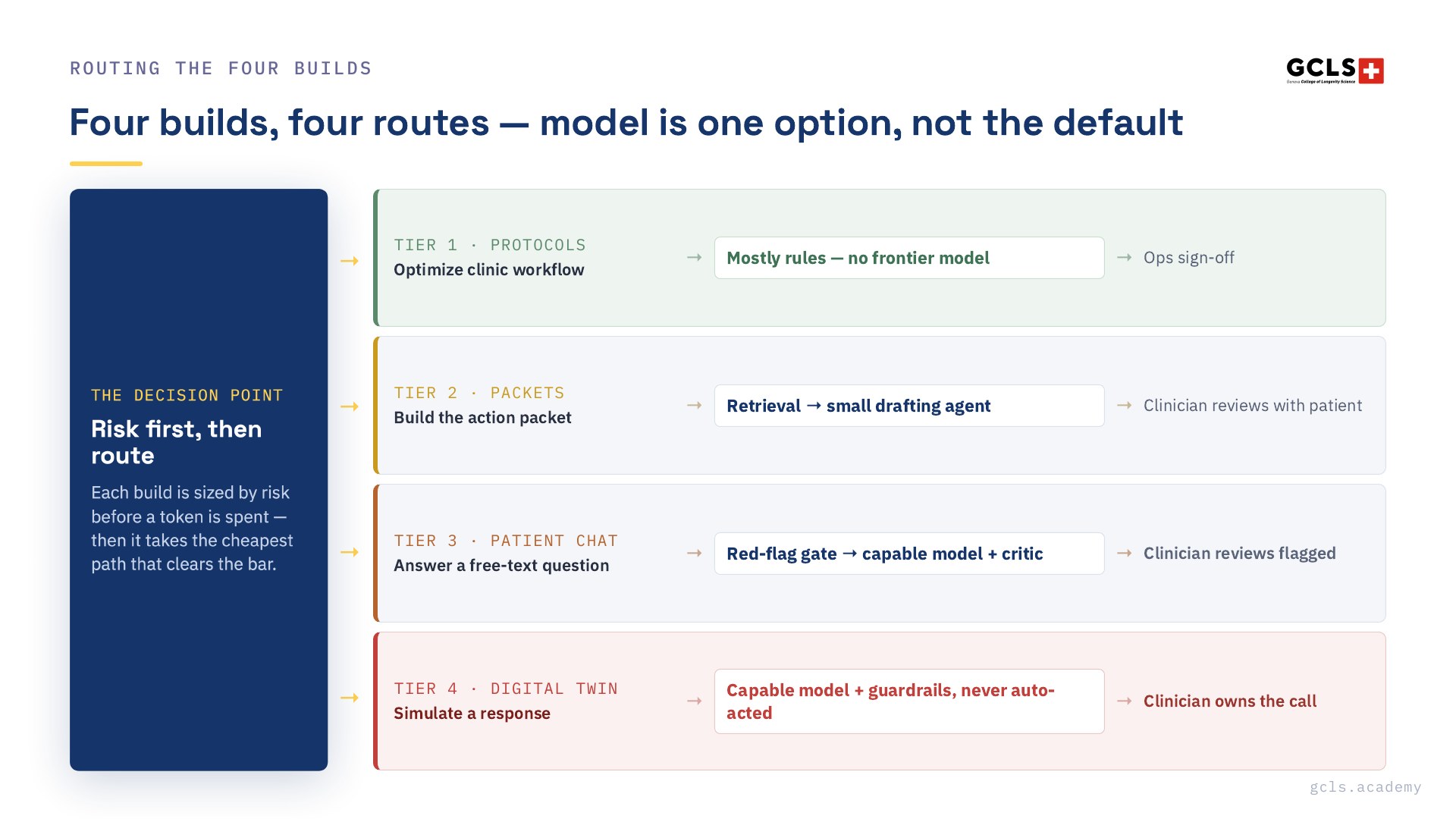
The webinar used four clinic builds to make the routing problem concrete: a protocol optimizer, a patient action packet, patient chat, and a digital twin style simulation. They may live in the same product, but they should not share one model strategy.
Closed-answer work
Protocol checks, eligibility, required fields, dosing math, and redaction should often be rules or database lookups. There is no reason to pay a model to rediscover a known answer.
Judgment-shaped work
Open patient questions, thin evidence, ambiguous context, and simulation require stronger reasoning, guardrails, critic checks, and clinician ownership of the final call.
The right levers are architectural
The strongest cost moves are rarely model swaps alone. They are architectural choices: deterministic pre-gates, minimum sufficient context, smaller models for bounded drafting, retrieval that sends only the few passages that matter, cache rules for stable sources, and post-validation before anything ships.
Evals are the control system. Without evals, optimization is guessing. With evals, each cost change becomes a measured trade: did accuracy hold, did red-flag capture hold, did citation quality hold, did clinician review time fall, and did the accepted outcome get cheaper?
The demo app gives learners a way to test the tradeoffs
For GCLS certification course learners, we built an interactive clinical AI cost demo app alongside the webinar. It lets learners explore how token volume, model route, retrieval size, latency, and review burden change the actual cost of a clinical workflow. The point is not to memorize a price table. The point is to learn how architecture changes the cost per accepted clinical outcome.
That is the practical skill clinicians and healthcare leaders need before buying, building, or approving AI systems: not just asking what the model costs, but asking where the model belongs, what should be deterministic, how the output is validated, and who owns the final clinical decision.
Learner resources
Replay, deck, handout, source file, and demo app
The full resource kit is available to enrolled GCLS learners in the Webinar Hub. Public visitors can read this recap and enroll to access the complete replay package.
Learn to evaluate AI systems before they become clinical infrastructure.
The GCLS AI in Healthcare Certification teaches prompt engineering, AI-powered workflows, agentic systems, validation, governance, and a capstone built around real healthcare implementation.